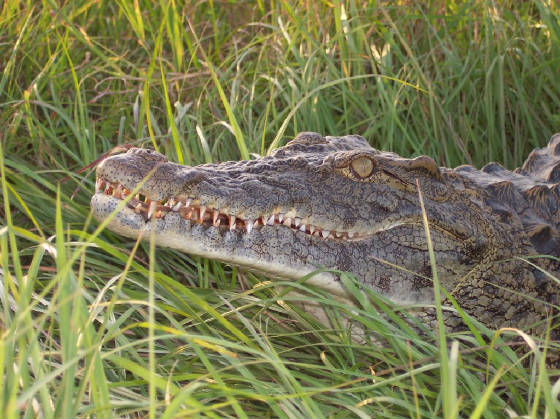
The genus Paleosuchus gives us a unique species of crocodilian
commonly called the dwarf caiman. This caiman is also referred to as Cuvier’s dwarf caiman and has become a mainstay
in the crocodilian pet trade. The dwarf caiman is one of the most fascinating appearing crocodilians in the world possessing
what has been described as a doglike skull. This animal has quickly field the niche’ in the United States pet trade
vacated by the now protected spectacled caiman.
A
native of the northern regions of South America the dwarf caiman tends to lead a rather solitary existence. The caiman is
not found in great numbers in any part of its range and tends to be found as a solitary animal or in pairs. In areas were
the more adaptable spectacled caiman are found the dwarf caiman may be absent or restricted to the faster moving waters of
streams and whirlpools surrounding the more open and quiet expanses of water to the spectacled caiman. This habitat partitioning
enables both animals to live successfully by fully exploiting environmental niches.
In
captivity the dwarf caiman has several very important characteristics that make it a popular captive. Chief among these characteristics
is the relatively small size as an adult. It must be remembered that this size is in relation to other crocodilians and that
the dwarf caiman is far from a ‘small’ animal. Males may reach five feet while the females four feet. These tend
to be maximum sizes and it may be more reasonable to expect three to four feet. The dwarf caiman is also among the most heavily
armored of the crocodilians; a characteristic that renders its hide useless for the skin trade. In fact this heavy armor makes
handling this species often times more difficult than larger members of other crocodilian species.
Another
important quality of this caiman is the ability to withstand lower temperatures than other caiman species. There are reports
of dwarf caiman feeding at temperatures in the 40’s. Perhaps this cold tolerance is an adaptation to the habitat in
which they live. Flowing mountain streams are generally much cooler than standing or slow moving bodies of water. This temperature
tolerance gives this species a wider temperature tolerance than many other crocodilians. That is not to say cooler temperatures
are preferred just that they may not prove fatal as quickly as in other crocodilian species. Dwarf caiman are nocturnal and
will spend their days hidden in burrows concealed from view. Upon nightfall they emerge to hunt for prey. In captivity this
crocodilian will require substantial terrestrial area as an adult. The water area need not be deep or large for adult animals.
A side benefit to keeping this species with a large land area is that adult dwarf caiman will typically defecate on the land
area. This makes keeping the water area clean much less of a chore for the keeper. It should also be mentioned that the enclosure
for a dwarf caiman would still be quite large for a reptile. A four to five foot dwarf caiman is a thick, bulky, large reptile
that will require an enclosure 3-4 times its total length at a minimum.
Dwarf
caiman will accept much of the same dietary fare as a typical crocodilian and the diet should center on rodents, poultry,
fish, and beef products. Rodents are particularly well received by this species. It may be necessary to deworm imported dwarf
caiman as an excessive parasite load may lead to animals that perish under the stress of importation. Removing the parasite
load prevents an opportunistic parasite from taking advantage of a stressed and weakened caiman.
The
dwarf caiman has a typical caiman attitude in that is normally quite feisty. This caiman is also more agile and athletic than
other caiman species and can be difficult to handle despite their smaller size. This fact along with the aforementioned armor
can make moving a dwarf caiman quite an ordeal. Despite the attitude a well-acclimated dwarf caiman is one of the most rewarding
of the crocodilians to keep due to their fascinating appearance and small size. Cuvier’s dwarf caiman is readily available
in the modern reptile trade both from specialty stores and Internet dealers. To date captive bred animals in the United States
are few and far between with virtually all animals originating as hatchlings from South America.